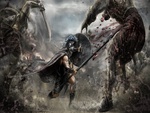
What drew me to this concept and has formed the basis of it, is this line from the NWN2 description:
I always like to have a bit of philosophy behind my characters, with their journey underpinned & driven by some form of unresolved conflict, and the exploration of free will would seem to be a natural fit. Here is a character who has been granted great power, for reasons unknown to them and towards an unspecified goal. Not only is that an awful lot of responsibility for someone to bare, it's also a burden that's been assigned by a Diety that they might not necessarily agree with. What effect would that have on someone's mind?Despite these powers, favored souls are often hindered by a sense of inescapable destiny that surrounds their births. They didn't choose their paths and may not want anything to do with their religion. In this way, the powers of a favored soul can be a burden rather than a blessing.
The character as I see it would struggle with self-doubt and uncertainty, scrutinising every decision that they make. They might often be paralysed by indecision. Are their actions truly their own? Have they made the right choice, or merely acted in a way that they unconsciously associate with their Deity?
Rather than embrace their calling, would they try to forge their own path? To what extent would they be successful, or would they be able to ultimately reconcile their doubts with their nature? These are the questions that I would like to explore.
The stumbling block comes with selecting the deity in question. To serve the character best, I feel that a deity would work who has some objectionable quality that isn't immediately apparent - so avoiding the obvious Good and Evil ones (ground too often covered). Kelemvor, for instance, would have been ideal - for reasons partially explored by Kaelyn the Dove in Mask of the Betrayer, but also for his conceptualisation of morbidity and impartiality. As he's not available in this setting, I've been going back and forth between Helm and Lathander.
Helm works for reasons of impartiality. Duty over morality would help fuel the conflict between free will and predestination. How far does Helm's protection extend? Yes, saving people from Orcs is fairly obvious - but what if those people are Evil themselves, or go onto perform great evils? Putting aside immediate dangers, what about social ills and injustices? How does one protect somebody from themselves? Is there a line between protection and aggression, and where does it lie? Also, swords are cool.
Lathander is interesting because his dogma seems to have quite a bit of fertile ground for a FS lik this to explore. A character selected before birth to serve a God that expects their obedience in return for divine power might find themselves at odds with that God's focus on renewal. What room do they have to embrace rebirth when their fate is predestined (or, at the very least, tied to Lathander's influences)? How do they become a symbol of hope and inspiration, when they are barely able to inspire themselves?
Either option, I feel, would serve the concept well - but I would like to throw this open to for comment in case there's something I'm missing or have overlooked, or if there's a more suitable option within the FR pantheon. This would be my first venture into playing a divine character in D&D so I am keen for feedback on what would work from those who are more familiar with the Deities that I am.