Teehee! I love flying

As a matter of fact, for me it is a way of living. I would not be able to do without.
Being an airline pilot myself at a big airline I made my hobby my profession and guess what... I am terrified of heights! My knees were shaking when I watched down from above the grand canyon into the deep, seriously shaking... But with flying it is a whole different thing. You have a set of wings and roaring engines etc to keep you up. Jumping out of an airplane??? Are you insane? Why would you jump out of a good working flying machine!
Aaand yes, sitting in the back of an airliner does take the control out of your hands but just know you'll have 2 competent people in the cockpit with a lot of training. Before you even start flightschool you have to be tested. Mentally, physically, coordination skills, technical knowledge and a whole bunch more. From all those people applying only 5% make it. (So the chance of the pilot being a troll can be neglected XD Oh, and btw, every flightprofile is being monitored. Really, you don't want to try a barrelroll with an airliner

) Then... after training and tests and tests and tests (You may fail once for a test...fail twice and you are out) you finally have your licences and can search for a company. At that company you will be tested again. Tests are your life when you are a pilot really... Now at my company (and at every other renomated company) You get simulator sessions every 6 months in which they throw the nastiest crap at you. Your plane will break down on multiple systems, you lose engines, the weather gets from bad to worse and even beyond that, but you are well trained to handle it. In the UNLIKELY case of a real emergency, your pilots will routinely work it out. Most of the times you don't even notice in the back something is going on. Trust us, we're professionals

Aspect of Sorrow wrote:In an automobile the minute changes can be felt for the direction you take, in an aircraft you've had a sudden drop of hundreds of feet before being able to react, and worse, which way is up if you're flying IFR (night / inclement weather) where you have to make judgement calls if one set of instruments fails and that transition is where most crashes also occur.
Sure, in a car you lack the extra axe you move with in an airplane. But dropping hundreds of feet is a scanproblem for novice pilots. You will learn to anticipate. The same counts for IFR flying. Vertigo is something novice pilots will learn to deal with and the golden rule is: Always trust your instruments!
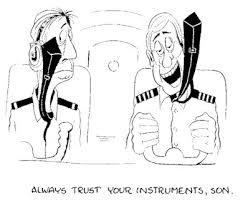
Instruments fail? Not so much...and if they do, not a big deal. You have extra sets of channels. (mostly 3 or 4 different channels) The computer picks out the one that is faulty and automatically switches to a proper channel giving you a notification on your panel. And if all that fails? We still have our emergency instruments that work. (They are mechanical and not electrical etc) Plus you also have your GPS that gives you the correct information.
Aspect of Sorrow wrote: Even trained commercial pilots have read air speed indicators wrong (frozen pilot tubes), where auto-pilot disengages, the auto-thrust disengaged, the turbulence forced the aircraft to bank right and the pilot overcorrected, sending the aircraft to stall for three minutes until it hit the ocean at 150 knots.
If the A/T or A/P go out you simply fly without. Every take off and almost every landing is done from hand.
I guess you are referring to the Air France crash? Well, on very, very, rare occassions it happens. Mostly in the past though. From every accident or crash that happened flight safety reports are made, pilots train these situations in the simulator and if needed technic of the aircraft is adjusted as well. So the likelyhood it happens again is limited as much as possible. Seen all the airplanes flying per day and the amount of actual accidents flying is still the safest way of transport. (And let's not forget the incidents that are very rare but still happen way more than the actual crashes but where the pilots just solve the problems) Mostly with accidents like these there is also a certain background story to it. I could go in detail here but then it would be a bit too much to type for now
I can say though, I flew exactly this flightprofile in the simulator not too long ago (blocked pitots etc and unreliable airspeeds) No problem if you go 'back-to-basic' pitch-power flying. You just KNOW that the nose of your airplane, with that particular speed, at that altitude and that amount of thrust can't fit and something is wrong with your airspeed.
So, for all those people that are scared to fly: No worries! It's the safest way of transport
For all those that love flying: Many happy landings to you!
 )
)

