A THEORITICAL MODEL OF VISUALISATION
- A Study of Divination, Enchantment, Transmutation -
Vol.1 - Language and Weaving
by Victoire Chevalière
ABSTRACT
Often times, the study of Weaving and all related subjects focuses and relies on the two ends of a given spectrum: cause and effect, technique and result, source and demand. Of course, these models make it easier to design equations that contribute to our understanding of Weaving. Still, binary models can only do so much for our comprehension of the intricate nature of Weaving itself: they prove practical, but fail to account for the missing pieces and remaining gaps.
In this series of essays, I seek to propose a new theoretical model in which:
-Weaving is tied to language and knowledge, treated as information: parameters and data.
-Divination, Enchantment, and to some extent, Transmutation (schools) can be explored, understood, and visualised as echoes of the very nature of Weaving itself: I will not study them as mere results (produced by techniques), but will instead treat them as integral parts of the fabric of Weaving.
In the present essay in particular, I seek to lay some of the foundations of my model, through the prism of the complex, multi-faceted relationships between incantations, language, and meaning. Overall, my demonstration seeks to open a space for new theories; and collaborations with other scholars or experts of all types.
References:
- Valilu Damira Tolruevren, Threads of the Infinite
- Khelben "Blackstaff" Arunsun the Elder
I) Incantations and language
I pose a question: what are incantations?
This seemingly trivial question in fact defines one of the foundations of our Art.
Most mages, of all sorts, would find it confoundingly simple. Some would argue it is too trivial to answer or even that the question, and the answer it convokes, does not matter. Others, in an inability to provide a sufficient -or, sufficiently satisfactory- answer, would ask: is it about verbal components in Weaving?
So, is this merely a matter of language? Could this be a sheer matter of preference or culture? In any language, many different words come to designate one same thing, but that general understanding of things is but a fallacy, because in fact, a new word is born from a need that another word fails to fulfil. Two synonyms never exactly convey the same meaning, nor do they exactly fulfil the same function: each achieves a different effect. The difference is all the more vaster from one language to another: two words from two different languages, seemingly designating the same object or concept, actually refer to notions that overlap in shared realities, but exhibit differences in cultural comprehension, meaning, differences related to a gap in mental and social patterns, because of distinct cultural mindsets.
The case of incantations is arguably worse. So-called "verbal components" are taught by wizards to wizards in the vast majority of Weaving classes and arcane schools. Yet a wizard is not a mage, for a wizard is a class; and a mage, a function. In some cultures, some nations, even some circles or courts within the same land, a mage is a title, just as an enchanter does not necessarily practice enchantment at all, just as enchanting an object is not always tied to the school of Enchantment. Do you still follow?
The point is: "verbal component" is just one specific lexicon. It is hard to accurately trace its origins back to its roots, but it has been maintained in usage by the Church as the generic term for the sake of studying and teaching Weaving.
Yet, the way wizards practice and teach confines the term to such studies, including mine. We ought not forget that in a broader scope, mages of all walks also teach mages of all paths. "Verbal components" merely represent a facet, a shared set of knowledge, and an approach or view of Weaving. In that sense, sorcerers also use "verbal components", but to them, the incantations seem to come naturally: is it still correct then to refer to them as such, while evidently, the phenomenon is different? For the most part, the answer could be: yes. It serves the purpose of uniformity: a form of translation that allows shared realities, so we can all speak the same "language" and therefore, share knowledge on a common basis.
Now, let us also consider that in rare instances, wizards have been known to successfully teach their verbal components to sorcerers. Besides, later in our career, each of us distorts the initial teaching of verbal components into our own fashion, making it personal and unique. We each learn the principles before turning them into our very own Weaving, and it still works. Bards are, perhaps, the most eloquent illustration of this phenomenon of individuation: entirely different sets of words or even just sounds (hummed notes, melodies sung by instruments, beats played on drums) still converge to the same results. And then again, results, from one individual to another, differ, not merely on the basis of mastery or power, but also on the paradigm of effects.
Fundamentally, it shows that the generic term "verbal component" fails to encompass such intricacies. I would rather propose the following definition to account for the discrepancies: incantation, regardless of its nature, is a sequencing of meaning. Rather than focusing on it as a practical and applicable unit (a component), I would rather treat it as a process.
............................................................................................................................................................................................................................................................................................................................
II) Incantations: a reinterpretation of the world by the mind
As previously declared: verbal components are to be understood as techniques. As such, their efficiency can be measured and different sets of techniques can be compared to others, in a result-focused approach. In that regard, the following observation can be made: different methodologies seem more or less efficient for certain categories of spells. Specialists and cabals have proven this time and time again, creating their own rituals to reinforce certain spells, cast in a certain fashion. Thus, most have come to a logical conclusion of cause and effect: that certain units of incantations are more efficient to achieve certain effects.
Yet, the possibility of individuation, with bards being the most extreme examples, as previously evidenced, seems to contradict this conclusion, that a certain sign or signal equates to a certain degree of effect. More precisely, it can be inferred that both possibilities might coexist, since historically observed, which seems to negate the first conclusion, without ruling out: in other words, this suggests the observation to be incomplete, rather than wrong.
From this reasoning, my conjecture is this: the Weave has been defined as "a bridge to the unknowable" (Arunsun), and I concur with Tolruevren's observation that "without this conduit, mortal minds and bodies would be utterly incapable of withstanding raw magic's overwhelming force" (Threads of the Infinite). Along this trail of thought, I would suggest that incantation is a process of sequencing, enforcing meaning, structured upon individual (re)interpretation of the world: to clarify, incantation serves as a multi-layered interface between the Weave and the mind, then between the mind and the world. It is a phenomenon that takes place as the mind touches the Weave with our mortal's capacity for perception: it turns the Weave, and the act of Weaving, into something the mind can comprehend, and is conditioned to our individual understanding of the world. Should you prefer an analogy, I would describe this as an individual's knowledge creating ripples, trembling reflections at the surface of the Weave: these ripples splash across the mind, surging into sounds, syllables, words, sentences, in music or literature of all kinds, in languages spoken or unspoken, the individual can make sense of. Those "words" then guide the mind into the realm of possibilities: the second step of interfacing, through which the act of Weaving reinterprets the world, predicating new meaning -effects, alterations- to it, through the use - and, in the case of silent casting: the notion of language (and here, language should be understood as the connection between meaning and the idea of speech, whether physical or mental: a system in which a sign produces a certain meaning).
The more we witness it happening, the more it becomes true: the act of witnessing enforces meaning, inscribing the outcome as an existing possibility in the realm of the known. The more of us practice a certain incantation -or any form of ritualisation at large- the more it takes shape in our collective intelligence and imagination: practice becomes cultural, consolidating the framework of Weaving. Therefore, Weaving, through the process of incantation, oscillates between this set of collective knowledge that sustains its own reality/possibility, and the individual's mind constantly reinterpreting this knowledge.
(It should be noted that Power Word spells and true names at large solidify the present theory as well as my conviction that there exists something similar to a plane or fragments of overlapping pocket-planes -perhaps even an extension of the Shadow Plane- that should reflect or embody the emanations from this sphere of collective knowledge.)
As a consequence, Weaving can be taught across various practices that intertwine in shared possibilities: it stands as both a collective and individual practice.
............................................................................................................................................................................................................................................................................................................................
III) The paradox of possibilities in Weaving
As previously proposed, incantations are performative: we speak them, therefore things occur accordingly. As such, the "words" of incantations shape our world, both tangibly and on the conceptual level: they open us to new possibilities of having power over the world.
On the other hand, words also limit our understanding of the universe, or rather, our ability to imagine possibilities our minds would deem plausible and likely to happen. Through words, we shape our understand and, more tangibly, our perception of the world: colours only exist in the eye of the beholder because they know the words to name and describe them. On top of this macroscopic phenomenon, a certain shade of a certain hue can only exist in the solitary realm of the individual, unique in its perception, making it almost impossible to share or recreate it in the eye of another.
In that regard, incantations are also performative in the sense that they construct, consolidate, sustain, and ultimately, limit our ability to Weave, because incantations depend on our mind's ability to form ideas and words, regardless of the language, spoken or purely tied to the practice of Weaving. Incantations are the possibilities and limits of our minds to think out of the box called knowledge. Therefore, the realm of the known is both the environment in which we thrive and the curtain that veils our comprehension of the universe. And the only way to think out of the box is: the path to innovation and discovery, while bearing in mind that knowledge begets and limits knowledge. (The irony of it carries a singular charm.)
By extension, I draw this conclusion: that my theoretical model exemplifies how the universe can be defined and perceived as a reflection of the realm of possibilities just as much as it keeps on expanding it: I propose we conceive the universe as an oscillation between different plausible states rather than a constant or fixed reality at any moment in time. (This is the main principle on which my studies of Divination are based.)
............................................................................................................................................................................................................................................................................................................................
IV) The concept of Pixeme: weaving information
Based on this theoretical model, I adjusted and developed my own practice of Weaving around those principles of knowledge and information. Allow me to introduce the Pixeme: a seme -a semantic unit: a sign carrying meaning- that is but a single building block, to be weaved with many others into a bigger picture. Essentially, a Pixeme is information given form through Weaving, and stands as the foundation of my Art. A single Pixeme is created by condensing information. At its core, it contains four types of elements:
- Constants.
- Variables.
- Schemes.
- Patterns.
In this technique, constants and variables are raw materials to cast a spell: constants represent fixed states while variables are interactive with constants, with each other, and with their environment at large.
Schemes lie in spaces in-between, filling certain specific gaps to bridge constants and variables together, but they do not simply hold the structure of a Pixeme: they exist between notions and perceptions. As an analogy, you can see them as sensors, enabling the Pixeme to be responsive to both internal and external factors. They constitue, on their scale, a modelling of the interfacing principle of the Weave, as described in (I).
On the conceptual and casting level, patterns [Annex 1] are motifs and designs stored inside a Pixeme, to be deployed as arcane schematics, enabling the Pixeme to form networks with other Pixemes [Annex 2], either by reaction and extrapolation -calculated from interacting constants and variables, restructured into new equations- or by self-iteration and duplication [Annex 3]. On the operational level, patterns are what turn Pixemes into actual spells.
Around those elements, a malleable shell of inertia is weaved to protect the internal structure (core) [Annex 4 & 5], stabilising the entropy generated by the various interactions between different pieces and sets of data. While entropy produces instability -within acceptable margins- it also enables oscillation, mimicking the actual state of the universe and what we may call the future: a state of the universe to come. I designed Pixemes in this way precisely because I believe it is the best way to cover as many possibilities as possible.
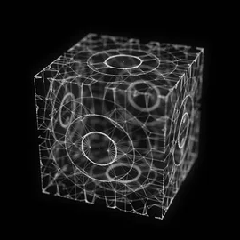

Annex 1 & 2

Annex 3

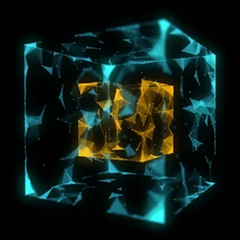
Annex 4 & 5I admit the technique to prove challenging and, to some extent, unnecessarily complex, even cumbersome. The instability tied to entropy makes it difficult to wield in order to cast heavily energy-focused spells, including most Evocation spells - unless they required precise fine-tuning. However, this model of Weaving makes it possible to control multi-factored spells simultaneously on the macro and micro-level, not with greater ease, but with greater efficiency, with the possibility to anticipate and program arcane systems for self-adjustment, significantly decreasing the mental load of constantly changing parameters.
Within this framework, it is my belief that, beyond its theoretical scope, the present model can serve to hone a Weaving methodology much more fitting for most spells under the classification of Divination, Enchantment, and Transmutation.