Beneath the high arches of Baldur’s Gate tavern's, where lanternlight settles in warm pools against worn stone, The Moonlights Muse stands with her harp in quiet readiness.
She does not call for attention. There is no overt beginning, only the subtle lift of her hands as they find the strings, and the first note drawn out, clear, measured, and unhurried.
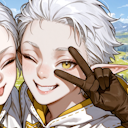
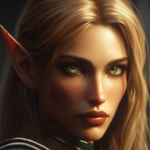
In the dappled moonlight spilling through the tall windows behind her, her visage is awash with a gentle, mirthful calm, something settled, something at ease. The silver-white of her hair catches that light in faint highlights, while the deep sapphire of her robes holds both the cool glow of the night and the warmer tones of the tavern’s lanterns. A silver-and-moonstone brooch at her throat glimmers softly, its light subdued but steady.
The harp rests close, its polished frame reflecting flickers of silver and blue. Her fingers move with practiced familiarity, precise, lightly curved, never rigid, as they draw sound from the strings. Each motion is deliberate without appearing forced, guided by habit and quiet discipline rather than flourish.
Around her, small motes of blue light drift at an unhurried pace. They gather and disperse without pattern, lingering near the harp and along the folds of her sleeves, their glow subtle against the interplay of lanternlight and moonlight.
The melody unfolds without urgency. Notes are placed with care, allowed to carry and settle before the next follows. There is no rush to it, no visible strain—only a steady shaping of sound within the space she occupies.
Her gaze remains soft and unfixed, neither seeking nor avoiding the room around her. She stands within the moment rather than apart from it, her presence defined less by display and more by a quiet constancy, as the music continues beneath her hands.
The melody carries for a time on its own, shaped by her hands and the steady rhythm she sets, before something in it changes—subtle, but deliberate. A note lingers a fraction longer than the rest, held just enough to mark the turn, as her breath draws in quietly between phrases.
When her voice joins, it does so without force. It rises into the space with a clear, unstrained tone, soft at first, yet steady—woven carefully between the notes of the harp rather than laid over them. There is a natural cadence to it, shaped by the same measured control as her playing, each word given room to form fully before yielding to the next.
The timbre carries a gentle brightness, touched by that same cool clarity as the moonlight behind her, yet warmed at its edges by something more grounded—something human, lived-in. It does not seek to dominate the room, nor retreat from it, but settles into the space with quiet assurance, supported by the consistent, guiding presence of the harp beneath her hands.
Her posture remains unchanged, her expression composed, as voice and instrument move together—one continuous thread of sound now, rather than two.
And with that, her new song begins.
I have sailed all Seas in fair a wind,
sought mermaids all and distant kin,
oceans wide and homely ports,
but all our time was still too short!
I spend time ashore to search for you,
rekindling lovers flame anew,
but though I searched there far and wide,
my home is on the shifting tide!
Recalled by the ocean’s rolling waves,
my heart still lost inside a haze,
into the depths and plunging down,
reminding me how love can drown!
Through silver lanes where moonbeams glide,
I chase your shade on every tide,
the stars above keep silent still,
as if they test my heart and will.
Violet, where have you gone?
Did I forget, or did you run?
Our story had not yet begun—
you were my stars, my moon and sun.
The nightwind hums a siren’s tune,
and lights the sea with Selûne’s moon,
her argent path I dare to trace,
in hope it leads me to your face.
Yet waves erase the dreams I weave,
and leave me naught but nights to grieve,
each dawn arrives, yet you are gone,
a ghost that sails the dark till dawn.
The lantern’s flame is swallowed whole,
by midnight’s tide and starlit shoal,
and still I pray to find you there,
in Selûne’s calm and silver care.
But faith must stand where charts fall short,
beyond the reach of any port,
and trust the tide that pulls me true,
might bring my wandering heart to you.
Violet, where have you gone?
Did I forget, or did you run?
Our story had not yet begun—
you were my stars, my moon and sun.
Beyond the line where sea meets sky,
the darkened depths still whisper “try,”
yet every swell and shadowed crest,
could hide a haven—or a test.
The ocean swells with voiceless might,
its vastness blinding mortal sight,
but see—above—her silver crown,
Selûne shines to calm me down.
Around me swirl her moonlit spheres,
they dance away the gnawing fears,
each glowing mote a wordless vow,
that love is worth the seeking now.
O Violet, my guiding star,
whether you dwell near or afar,
I’ll follow light through night’s domain,
till moonlight leads me home again.
I’ll follow light through night’s domain,
till moonlight leads me home again.
The final notes do not fall away so much as they are allowed to fade, gently released from her hands until the harp itself is silent once more. For a moment, she remains where she stands, the last resonance still lingering in the air between lanternlight and moonlight.
Her hands lower with the same unhurried control that marked her performance, resting against the harp’s frame as though acknowledging its weight before letting it go. There is no pronounced conclusion, no gesture meant to signal an end, only a quiet settling, as if the music has simply reached its natural rest.
In the dappled light spilling through the tall windows, she turns slightly, her silver-white hair catching the pale glow of Selûne beyond. The blue motes drift with her as she moves, unhurried and unforced, like fragments of the same light that touched her throughout the performance.
She does not seek attention as she departs. Instead, she moves through the space as it continues its own life around her, step by step, into the cooler spill of moonlight beyond the tavern’s threshold.