
Every seed that lives must eventually branch.
I did not know that then. I thought roots were only for holding fast, and perhaps that was all I wanted when I first came to the Gate. A place to stand. A bed that would still be there when I returned to it. A road that did not immediately demand I keep walking. Yet roots do not only hold a thing down. They feed it. They reach into dark places, through stone and old rot, and draw what life they can. Given time, what survives below ground seeks the open air.
So it was with me, though I would not have said it so plainly at the time. In those first days, I took what work I could find. The city had no shortage of small troubles for men with bows, blades, and more need than pride. Farmers wanted wolves driven from their fields. Merchants wanted bandits frightened away from the roads. A mining concern wanted ore fetched from places where honest laborers did not care to linger. The sewers had rats large enough to make a man reconsider what he believed about rats. There were missing goods, missing men, strange noises from cellars, and all manner of complaints that seemed simple until you put your boots on the road and found blood in the grass.
I told myself it was only for coin. That was true enough. Arrows cost money. So did food, lodging, oil, salves, repairs, and all the small things that keep a man alive between one danger and the next. Pride is a fine thing until your stomach begins arguing with it. But coin was not the whole of it. The city pressed close around me, and its walls, voices, smoke, bells, and endless press of strangers were easier to bear after a day beyond the gate. Even a hard day. Even a bloody one. Out there, the air moved differently. The land had room enough for a thought to finish itself.
That was where I first met Leon Falconclaw.
The work seemed simple when I took it. It always does, when described by the man who does not mean to do it himself. A farmer along the Coast Way had lost sheep to wolves, and by the time his tale reached the city, the wolves had become near as large as horses and clever enough to open doors. I had learned by then to treat such accounts as I treated tavern ale: useful enough, if watered down in the mind before swallowing.
Still, sheep had been taken. A farm dog had been torn badly enough that the farmer’s children would not go near the fields. Fear had a way of spreading faster than truth, and if nothing was done, some frightened fool would set poison where children, hounds, foxes, and every other hungry thing might find it.
So I went.
The farms along the Coast Way were not the wildest lands I had known, but they were not safe either. The road kept men moving, and where men moved, trouble followed. Wagons left ruts that filled with brown water. Crows watched the fields from fence posts. Smoke rose thin from farm chimneys, and beyond the last worked acres the trees gathered in uneven patches, as if the wild had not decided whether it meant to reclaim the place or merely watch it.
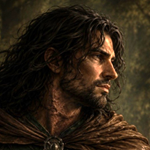
The farmer was still explaining the trouble when I noticed the young man near the track. He was crouched near the edge of a muddy track, one hand close to the ground, his head turned slightly as if listening to something beneath the farmer’s words. He had the look of a ranger, though I did not yet know whether he had earned it. Many men wore cloaks. Many carried bows. Fewer knew when to keep still. This one kept still well.
The farmer had apparently spoken with him before I arrived. Leon Falconclaw was his name, though at the time it was only another name on a road full of names. He was a young human ranger, new to the Coast or near enough that the difference did not matter, and he had already found the tracks near the ditch where wagon wheels had nearly spoiled them.
We took each other’s measure in the quiet way rangers often do. His eyes went to my bow, my boots, and the mud on my hem. Mine went to his hands, his footing, and the care with which he kept himself out of the track he was reading. It was not suspicion exactly, though there was some of that. It was more the habit of men who know that a cloak and a bow can lie.
The tracks were wolf. That much was plain. Not the great pack the farmer had promised us, but enough to trouble sheep, especially if hunger had made them bold. Leon thought they were running too close to the farms, and I agreed. More importantly, he wanted to know why before deciding what ought to be done.
That was the first thing I liked about him. Not that he knew the tracks. Any decent woodsman could see that much. Not that he was calm, though calm is worth more than most men think. It was that he did not begin with killing. He began with why.
We followed the trail away from the nearest field and into rougher ground where the grass grew high and the trees stood in broken clusters. The farmer came with us for perhaps fifty paces, then remembered some urgent matter involving a fence, or a gate, or his own good sense. I did not blame him much. Men who live beside danger are not always the same as men who walk toward it.
Leon moved lightly, but not in a showy way. He stepped where the ground allowed him, avoided dry twigs, and spoke only when there was something worth saying. A broken fern. A scrape on bark. Scat too thin for a healthy pack. Blood dark on a stone near a narrow ditch. The wolves were hungry, and more than hungry. The trail had desperation in it: sharp turns, wasted movement, and too much boldness near men.
We found the first snare before we found the den. It was an ugly piece of work, wire and bent iron hidden beneath brush, set without care for what might step into it. A poacher’s trap, or a fool’s. Sometimes there is little difference. Blood darkened the leaves around it, and bits of gray fur clung where something had fought hard to get free.
Leon’s face changed then, though only a little.
I knelt and worked the snare loose from the root that held it. The thing had bitten deep into the wood. Whoever set it had not been trying to hunt cleanly. He had been trying to hurt whatever passed through. That told us enough. An injured wolf, a frightened pack, less prey where they were used to hunting, and farms close enough to smell. Sheep were easier than deer. Dogs easier than wolves wanted them to be. Children, if hunger and fear pushed the matter far enough.
There was no victory in understanding it. Only the shape of the trouble made plain. The farmer had asked us to kill wolves. The land had asked something else.
We found the den near dusk. There were four wolves that we saw at first. Two lean adults, one young wolf near grown, and a limping she-wolf whose foreleg bore the torn mark of the snare. Pups watched from the dark behind her, small eyes catching what little light remained. The she-wolf lowered her head when she saw us and showed her teeth, not with malice, but with fear sharpened into warning.
My hand nocked an arrow. So did Leon.
Neither of us drew.
I had seen that look before. Not only in beasts. There is a kind of fear that bares its teeth because it has nothing left to hide behind. It is an honest thing, if not a safe one.
The farmer had paid for dead wolves. That would have been the simpler answer, easier to explain and easier to prove. But I had no wish to put an arrow into a mother guarding her young because some careless hand had set iron where it did not belong.
“Not this way,” I said.
Leon looked at me, but did not argue. I told him we would not slaughter the pack. He did not look like he needed convincing. We would break the snares, turn the wolves away from the farms, and give them enough room to flee without driving them into panic. If the farmer wanted pelts, he would have to be disappointed. There are worse things in this life than a disappointed farmer.
It took longer than killing would have. Most right things do. We broke three snares before full dark and marked signs of two more for morning. We moved carefully, giving the wolves room enough to withdraw without making them bolt toward the fields. Leon knew how to turn a pack with pressure instead of panic, and I knew enough of frightened animals to help. By moonrise, they had pulled back into thicker cover, and the farm lay quiet behind us.
As we made our way back toward the Coast Way, I glanced once toward the treeline and saw a doe standing half-hidden among the ash and thorn. She did not run, though most deer would have. She only watched us for a moment, ears turned forward, before the brush took her from sight. I thought little of it then, save that it was strange how still she had been.
The farmer was not pleased when we returned without pelts. I cannot say I blamed him. Men who pay for certainty do not like being handed judgment instead. We showed him the broken snares and the blood on them. We told him the wolves had been driven away from the fields. He argued, and I argued back more than was wise for a man hoping to be paid. Leon said little, which I later learned could be more useful than speaking when a man was determined not to hear.
In the end, the farmer paid less than promised and complained more than was necessary. The sheep were safe that night. And the night after. In time, that became proof enough.
Leon and I walked back toward the city together, though neither of us had said we would. The Coast Way was dark by then, with the last of the farm lamps behind us and the Gate a glow ahead. My boots were wet, my hands were scratched, and I smelled of mud, wolf blood, and old iron. It was not noble work. It would not be sung of. No lord would remember it. No priest would carve it into stone.
Yet I remember it.
Perhaps because it was the first time since coming to the Coast that I did not feel only like a man waiting for news that would never come. I had gone out beyond the walls, read the land, made a choice, and returned with someone walking beside me who understood why the choice mattered. That was no small thing.Somewhere along the road, Leon asked where I had learned to track.
“My father first,” I said. “Then an elf named Kolandir.” That earned a glance from him.
“Good teachers?” he asked.
“One was,” I said. “The other was my father.”
Leon seemed to understand the difference, or at least enough of it not to ask foolishly.
We spoke more after that. Not much. Enough. He had come to the Coast recently, though I no longer remember whether he said so plainly that night or if I learned it over the next few meetings. Memory joins things that life kept separate. He was new enough to still be learning the names of roads and ruins, old enough in the wilds that I did not need to explain every broken twig or shifted stone. That made him good company.
In those days, good company was rarer than coin. I did not know then how often our roads would cross, or what doors Leon would later open for me. I did not know that through him I would hear more of the circles and groves that watched over the wild places of the Coast. I did not know how many names would come after his, or how many of them would become part of the shape of my life.
At the time, he was simply another ranger on a dark road. Sometimes that is how branches begin. Not with a great reaching toward the sun, but with a small turn no one else notices. A path taken beside another. A job completed. A name remembered.
When we reached the city, the gate lamps were burning and the guards were in poor humor. Nothing within the walls had changed while we were gone. It still smelled of smoke, river damp, animals, hot food, and too many people living too close together. Somewhere inside, ale was being poured, dice were being thrown, and men were telling lies about dangers they had never faced.
I should have felt tired. I knew I was.
But beneath it there was something else. Not peace. I was not ready for peace. Not purpose either, not yet. Purpose is too large a word for what I had then.
It was more like the first green push of a thing beneath soil.
Small, uncertain, and easy to crush.
Alive all the same.


