Been a while. This time I'll put up some historical songs. Some of you already know that my academic background is in history -- so, naturally, popular music through the ages? It's right up my alley.
We'll begin with "Ue o Muite Arukō," released in Japan in 1961. To date, it's the only Japanese-language song to have made it to the top of the charts in the United States, and it's one of the best-selling singles of all time:
According to one BBC News respondent: "The Japanese song Ue O Muite Aruko (I Will Walk Looking Up, 1961) -- but inexplicably known in the US and UK as Sukiyaki (1963) -- did as much or more to change the attitudes of Americans toward their former enemies as any policy or speech. I am not old enough to remember the song coming out in 1963, but many older Americans have said this song marked the first instance where they began to see Japanese people not just as a former enemy or some mysterious, exotic race, but as people with feelings no different from their own, and capable of expressing beautiful, tender emotions. The effect went both ways. I lived in Japan for about five years, and many older Japanese shared with me how moved they were at the reception this song received in America, and this made them feel more positive toward their former foes. It is still to this date the only Japanese song to ever top the American charts. I do think it helped accelerate the alliance between Japan and the US that has maintained peace in the Pacific for over 50 years." John Taylor, Washington, DC (Source:
http://www.bbc.com/news/magazine-21143345)
Ironically, the song was actually written by Rokusuke Ei to describe how disappointed he was feeling after returning from a failed protest
against the Treaty of Mutual Cooperation and Security between the United States and Japan (1960).
Today Japan and the United States enjoy an extremely close political relationship, and Japanese culture has strongly influenced an entire generation of American children and young adults. And yet? A single lifetime ago, the two nations were literally monsters to one another. I suppose it just goes to show you how much can change in a lifetime?
Next up we have ...
I'll dedicate this song to Charraj, and all of our other lawyers. This song -- produced in 1728 by John Gay as part of his
The Beggar's Opera -- just goes to show you how far back jokes about lawyers go.
I love you Charraj. Please don't sue me.
And then we have ...
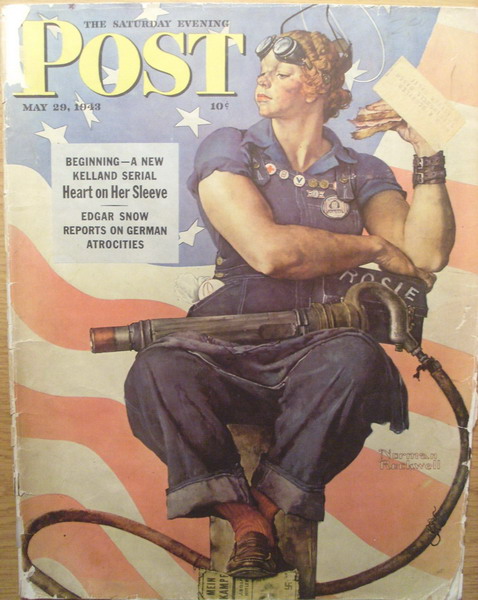
"Rosie the Riveter," written in 1942 by Redd Evans and John Jacob Loeb, glamorizes and memorializes the American women of World War 2. Because World War 2 was a total war -- that is, it involved and targeted civilians as well as combatants -- on an epic scale, the production of war materials required the mobilization of enormous segments of the civilian population.
Just as "G.I. Joe" (or "Tommy Atkins," if you're a Brit) was a cultural stand-in for the everyday soldier, "Rosie the Riveter" was supposed to represent the mother, sister, daughter supporting her soldier on the front lines. Although the song referenced above was the first use of the phrase "Rosie the Riveter," she was really popularized by Norman Rockwell's painting on the cover of the
Saturday Evening Post on Memorial Day, May 29, 1943:
If you've read all of this (and I'll not blame you if you didn't -- I tend to go on about historical subjects and, more generally, human culture) then I'll reward you with a secret glitch-hop rendition of the above song. Just click, and:
Enjoy!